The Architecture of Joá: The Architects Who Made History in Rio
"Geography created Joá. Architecture revealed it."
There are places where architecture seeks to assert itself through monumentality.
There are others where true sophistication lies precisely in the opposite.
In Joá, architecture learned that the leading role belongs to the landscape.
Perhaps that is why this small neighborhood in the west zone of Rio de Janeiro became one of the greatest laboratories of Brazilian residential architecture.
Over more than five decades, some of the most influential architects in the country found in this territory a rare challenge: to build on steep slopes, among massive granite outcrops, preserved Atlantic Forest, and one of the most extraordinary views over the Atlantic Ocean.
The result was not a single architectural style.
It was a philosophy.
To build in respect of the place.
Never against it.
A territory that challenges architecture
Designing a residence in Joá has never been a conventional task.
Unlike neighborhoods where lots allow repetitive solutions, here practically every plot has a different topography.
There are significant changes in elevation.
Rocky outcrops.
Protected vegetation.
Environmental restrictions.
Prevailing winds.
Very different sun orientations.
Each project begins with understanding the mountain.
Only then is architecture born.
Perhaps that is why so many residences in Joá have been published internationally.
They could not exist anywhere else.
José Zanine Caldas: when wood met the forest
To speak about the architecture of Joá is inevitably to speak about José Zanine Caldas.
Designer, self-taught builder, and one of the greatest names in 20th-century Brazilian architecture, Zanine found in Joá the perfect territory to develop what would become one of his greatest contributions to tropical architecture.
Between the late 1960s and mid-1970s, he designed several residences in the area, using large timber structures, natural ventilation, and careful placement on the slopes.
His houses seemed to emerge from the forest itself.
Instead of removing trees in order to build, he sought to adapt construction to the existing landscape.
This approach became so relevant that decades later it would be the subject of a master's dissertation devoted exclusively to Zanine's residences in Joá, demonstrating the historical importance of this architectural body of work.
Today, many of these houses are still considered part of the heritage of Brazilian residential architecture.
Sérgio Bernardes and the tropical architecture revolution
If Zanine brought wood to the center of architecture, Sérgio Bernardes revolutionized the way space was understood.
Far beyond aesthetics, Bernardes defended an architecture capable of responding to the tropical climate through technology, ventilation, and integration with the landscape.
His projects explored large structural spans, glass walls, and solutions that eliminated the boundary between interior and exterior.
Although his work extends far beyond Joá, the influence of his thinking became evident in countless residences built on Rio's hillsides.
Even today, many architects recognize Bernardes as one of the leading references in Brazilian tropical architecture.
Claudio Bernardes: the maturity of residential architecture
In the 1980s, Claudio Bernardes deepened this language.
His Casa Joá (1986) remains one of the neighborhood's most emblematic residences.
Wood.
Exposed concrete.
Natural stone.
Large glass panels.
Cross ventilation.
Everything was designed to allow nature to pass through architecture itself.
There is no excess.
There is balance.
It is precisely this simplicity that makes Casa Joá a reference to this day.
Thiago Bernardes and a new generation
The Bernardes family tradition continues through Bernardes Arquitetura, currently led by Thiago Bernardes.
Among the best-known projects is the Capela Joá, winner of the Architizer A+ Awards.
Small in scale, yet extraordinary in conception, the chapel almost disappears among the vegetation.
The materials reflect the forest.
The structure follows the terrain.
The ocean appears discreetly in the background.
More than a religious building, it has become a manifesto on the relationship between architecture and nature.
Indio da Costa and contemporary elegance
Among the contemporary architects who best understood the spirit of Joá is Luiz Eduardo Indio da Costa.
His Residence in Joá, completed in 2018, shows how contemporary architecture can dialogue with the landscape without resorting to excess.
Independent volumes are distributed across the slope.
Glass passages connect the different spaces.
Water mirrors reflect the sky.
The ocean accompanies the home's circulation throughout.
The interiors, designed by Duda Porto, reinforce this language through natural materials, discreet lighting, and décor in which the view remains the protagonist.
It is a project in which architecture, interiors, and nature seem to belong to the same composition.
Arthur Casas and quiet sophistication
Few Brazilian architects have achieved international recognition comparable to that of Arthur Casas.
In Joá, his Casa AL became an example of how to transform an extremely complex site into a residence of great elegance.
Rather than fighting the topography, Arthur Casas used it to create different planes, progressively framing the view of the Atlantic.
It is a quiet architecture.
Without excessive gestures.
Without the need to impress.
Perhaps that is why it remains so current.
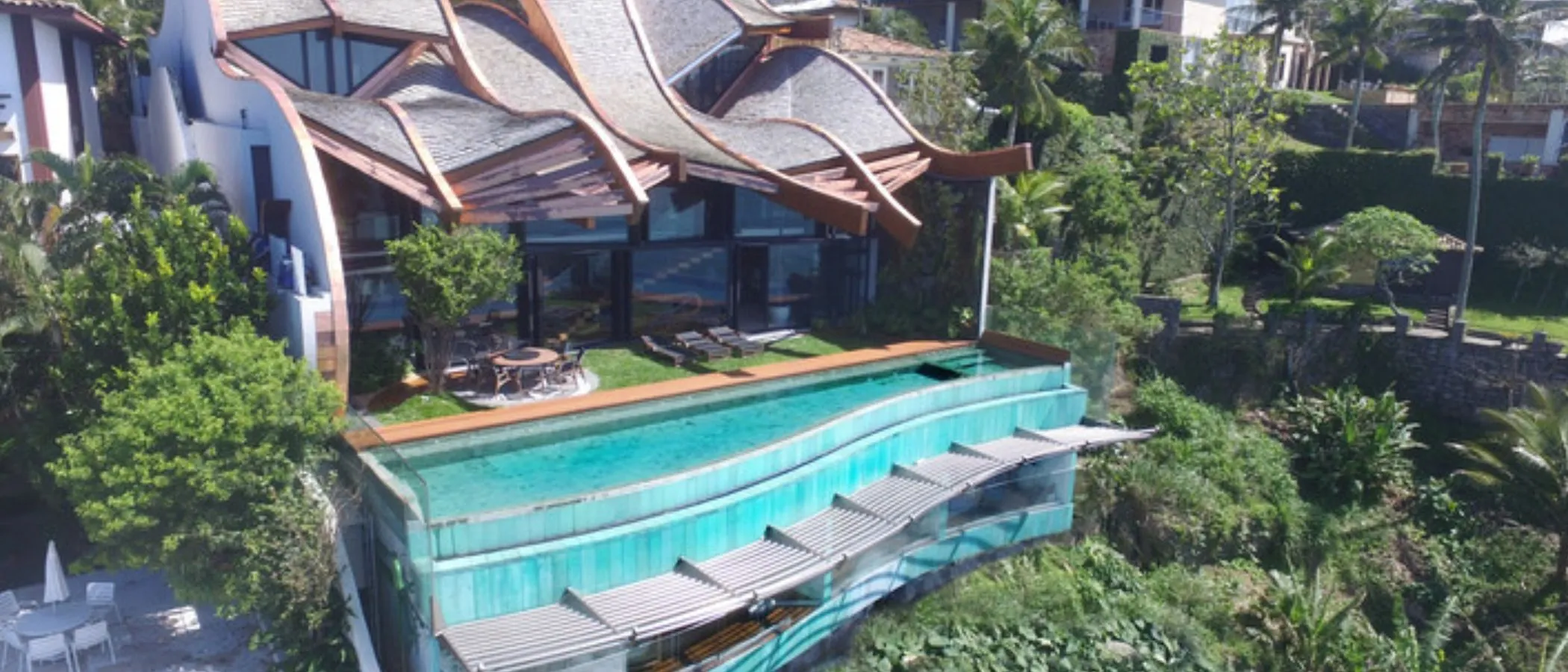
Casa Onda: when architecture is inspired by the sea
In neighboring Joatinga, within the same geographic and landscape context, lies one of the most internationally published Brazilian residential projects.
Casa Onda (Wave House), designed by the firms Mareines Arquitetura and Patalano Arquitetura.
The residence seems to emerge from a huge granite block.
The curved roof reproduces the movement of the waves.
The façades almost disappear before the ocean.
It is a project that shows how contemporary Brazilian architecture continues to innovate without breaking with the landscape.
Jacobsen Arquitetura and essential luxury
Although its work is spread across several regions of Brazil, Jacobsen Arquitetura represents one of the languages that most closely resonates with the spirit of Joá.
Large glazed surfaces.
Light structures.
Wood.
Natural stone.
Ventilation.
Integration with the landscape.
Rather than creating iconic buildings, the firm seeks to create places where architecture and nature coexist in an almost invisible way.
This is exactly the philosophy that explains why so many contemporary residences in Joá follow similar principles.
An architecture that belongs to the place
Perhaps it is impossible to define a single architectural style for Joá.
But it is easy to recognize a common principle.
The neighborhood's best houses never sought to dominate the landscape.
They sought to reveal it.
The mountain remains present.
The forest remains present.
The ocean remains present.
Architecture simply frames all of this.
And perhaps it is precisely this humility before nature that has turned Joá into an international reference in residential architecture.
At a time when so many projects seek attention, Joá reminds us that true sophistication can be quiet.
Because some of the greatest works of Brazilian architecture were never meant to impress.
Their only goal was to belong to the place where they were built.
About the author
Aline Sofia has followed Rio de Janeiro's high-end residential market for several years. Her interest in Joá goes beyond real estate: she studies the neighborhood's history, urban development, and architectural heritage, believing that understanding a territory is essential to understanding the true value of a residence.