Joá: History, Urban Evolution, and the Essence of Rio’s Most Selective Neighborhood
"There are places whose history is written through monuments. Others through the people who lived in them. Joá wrote its history differently: by preserving the landscape that gave it life."
Few neighborhoods in Rio de Janeiro can inspire so much admiration without ever seeking the spotlight.
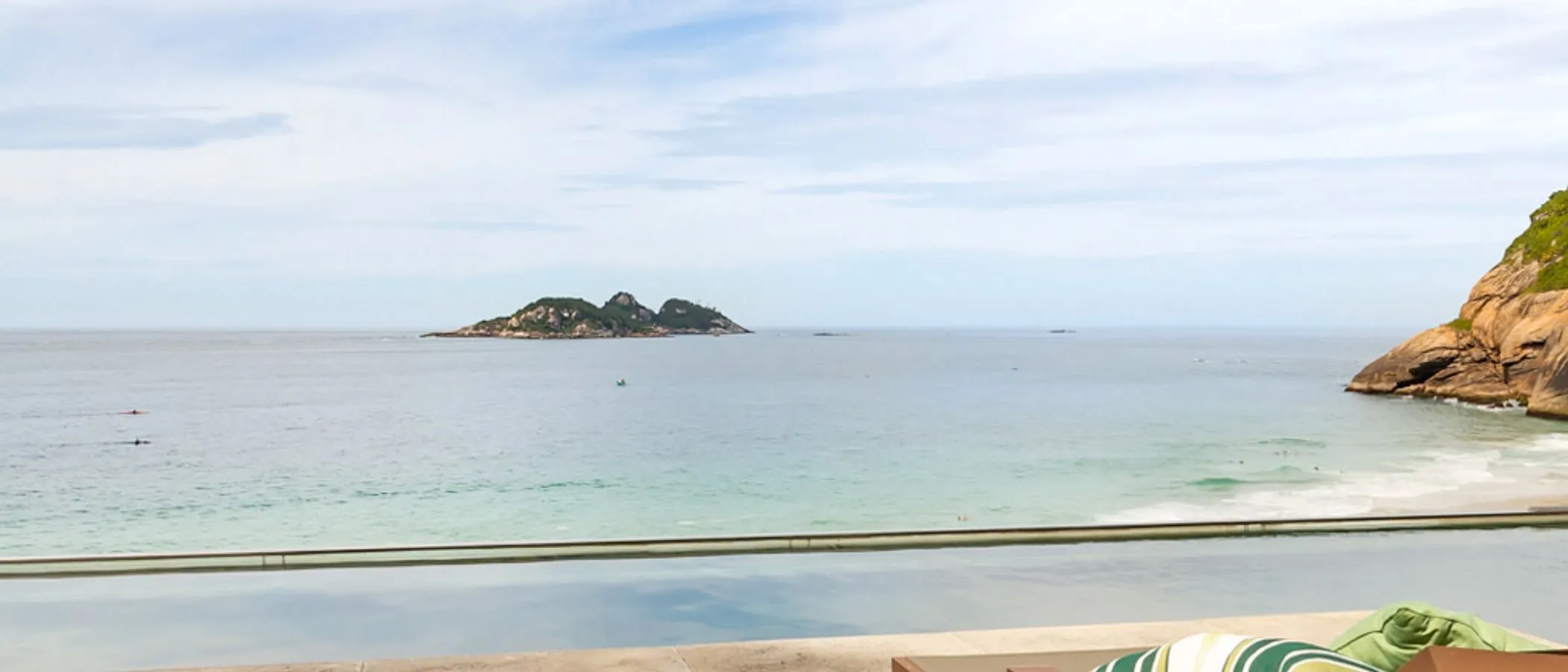
Between São Conrado and Barra da Tijuca, tucked between the Atlantic Forest and the Atlantic Ocean, Joá neighborhood remains one of the city’s last areas where nature still dictates the pace of human occupation.
Anyone arriving for the first time will hardly find what is usually associated with an upscale neighborhood.
There are no major commercial avenues.
There are no tall buildings.
There is no heavy traffic.
What exists is another way of living.
The streets carefully follow the contours of the mountains.
The houses appear discreetly among the vegetation.
The sea appears and disappears between the curves of the road, creating a succession of landscapes that seem to belong far more to a nature reserve than to a metropolis with more than six million inhabitants.
Perhaps that is precisely Joá’s greatest singularity.
It never sought to appear exclusive.
It simply preserved what it had always been.
And it was exactly this ability to resist the city’s more aggressive transformations that ultimately turned it into one of the most valued addresses in Brazil.
In the Joá real estate market, this appreciation is directly linked to the combination of low density, naturally limited supply, and strong landscape preservation. In a setting where there is almost no room for intensive expansion, each property combines rare attributes — privacy, views, silence, and location — which helps explain why Joá is so highly valued in such a consistent way.
Joá Rio de Janeiro: an impossible geography to replicate
To understand Joá, it is necessary to begin with its geography.
Long before the first homes were built, this territory already had very distinctive characteristics.
The area lies between the Tijuca Massif and the Atlantic Ocean, in a region where the Atlantic Forest slopes down almost to the sea, forming steep hillsides, large granite outcrops, and one of the most striking landscapes on Rio’s coastline.
This geological configuration deeply shaped the entire urban occupation.
Unlike neighborhoods such as Copacabana, Ipanema, or Barra da Tijuca, where urban expansion found relatively flat land, Joá forced engineers and architects to adapt every structure to the natural characteristics of the terrain.
For decades, this difficulty was seen as an obstacle.
Today, it is understood that it was precisely this that protected the neighborhood from overdevelopment.
Nature acted as Joá’s first master plan.
How geography shaped Joá’s urban evolution
This natural condition helps explain Joá’s urban evolution.
Instead of expansive, homogeneous urbanization, the neighborhood developed in a restrained way, always in dialogue with the physical limits of the land. More than a backdrop, the landscape became a structural factor in defining its residential identity.
History of Joá: the origin of the name and its connection to the landscape
Although there are different interpretations of the name’s origin, the most widely accepted explanation links “Joá” to the fruit of the Solanum capsicoides plant, commonly known as joá in Portuguese.
This species, common in the Atlantic Forest, produces small orange fruits covered with thorns and was part of the native vegetation found in the area before urban occupation.
As happened in so many other Rio neighborhoods, the territory ended up inheriting the name of an element from the landscape itself.
It is a simple origin.
But deeply symbolic.
Even in its name, Joá preserves a direct connection to nature.
How Joá neighborhood emerged: isolation, access, and urban transformation
For much of the 20th century, Joá was a difficult area to access.
Connections between the South Zone and Barra da Tijuca were made through narrow roads that followed the coastline and the mountain slopes.
The geography itself made any significant urban expansion difficult.
It was only with the opening of Estrada do Joá, still in the first half of the 20th century, that the area slowly began to integrate into Rio de Janeiro’s urban fabric.
However, the real transformation came in 1971, with the inauguration of the Lagoa-Barra Expressway, one of the city’s most important road projects.
The new link definitively brought Barra da Tijuca closer to the South Zone and profoundly changed the region’s urban dynamics.
Curiously, unlike many other neighborhoods that benefited from new infrastructure, Joá did not respond with an real estate boom.
It responded with restraint.
The geography continued to impose limits.
Environmental legislation became stricter.
And the neighborhood’s residential vocation became increasingly consolidated.
This combination made it possible to preserve a rare urban quality in contemporary large cities.
Where Joá is located and how it connects to the city
For those wondering where Joá is located, the answer helps explain its singularity: the neighborhood is positioned between two major centers in Rio, acting as a very particular transition between the South Zone and Barra.
This geographical condition made Joá a strategic passage point, while still preserving its residential scale. It is precisely this tension between connection and shelter that runs through its urban history.
To deepen your understanding of the neighboring areas and the region’s dynamics, it is worth also exploring our content on São Conrado, Barra da Tijuca, and the real estate market in Rio de Janeiro.
Joá real estate market: growth without losing identity
Joá is often described as an exclusive neighborhood.
But perhaps it is more accurate to describe it as a selective neighborhood.
The difference matters.
Exclusivity can be created.
Selection happens naturally.
Joá was never designed to accommodate large developments.
It was never planned to receive high population density.
Its physical characteristics prevented that growth.
The result is a territory where low occupancy is no longer just a consequence of geography.
It has become one of its greatest assets.
Today, anyone walking through the neighborhood can easily perceive that difference.
There is space between residences.
There is vegetation between lots.
There is silence.
There is horizon.
At a time when so many cities seek to grow vertically, Joá shows that true value does not always depend on how much is built.
Often, it depends precisely on what is chosen not to build.
What makes Joá exclusive in the residential context
This is where what makes Joá exclusive becomes clearest.
It is not just about construction standards or a privileged location. It is about a rare combination of restrictive topography, controlled occupation, constant vegetation, and an uncommon relationship with the city’s pace.
From a real estate perspective, this means a neighborhood where scarcity is not artificial. It stems from the territory itself. And therefore, it has a decisive influence on how property value is perceived.
Joá neighborhood between two worlds: location, routine, and appreciation
One of Joá’s greatest virtues rarely appears in photographs.
Its location.
Few neighborhoods manage to strike such a balanced relationship between isolation and accessibility.
In just a few minutes, it is possible to reach Leblon, Lagoa Rodrigo de Freitas, São Conrado, or Barra da Tijuca.
Leading hospitals, international schools, business centers, clubs, restaurants, and services are close enough to make daily life easier, yet far enough away for the neighborhood to preserve its residential atmosphere.
It is a quality that is difficult to replicate.
And perhaps it is precisely this that continues to attract families looking for more than a house.
They seek a place where the city no longer takes center stage.
In that sense, location helps consolidate not only the neighborhood’s identity, but also its strength in the market. Between intense urban life and a sense of shelter, Joá maintains a rare position in Rio de Janeiro: that of an address that remains close to everything without giving up almost anything that makes it unique.